Vision Zero without a goal is not Vision Zero
‘Business as usual is a business of death’ was the grim but accurate assessment of global road deaths by the UN’s Special Envoy for Road Safety, Jean Todt, at the first General Assembly meeting on road safety, where members voted to halve road deaths by 2030.

Vision Zero is an evidence-based road safety methodology that aims to eliminate traffic deaths and serious injuries. It is more than a mere philosophy or ethos - its implementation has achieved success throughout the world, including in North America. Cities that have adopted Vision Zero do not simply acknowledge that traffic deaths are unacceptable, they set measurable goals, track progress, and systematically redesign transportation systems to reduce harm.
By contrast, the 2024 HRM Road Safety Strategy marked a significant retreat from the more ambitious collision targets adopted in HRM’s 2018 Road Safety Strategy. Rather than strengthen Vision Zero actions in the face of increasing road deaths, staff and Councillors have weakened them.
How do we know this? Because HRM’s new strategy adopts the language of Vision Zero but not its central commitment. The municipality expressly adopts a Vision Zero concept, not the real thing. The 2024 Road Safety Strategy references a vision of zero deaths and serious injuries by 2038 but does not establish an operational goal to achieve that outcome. So, while HRM's “vision” is zero deaths and serious injuries, its operational goal is to maintain a downward trend in collisions per 100,000 residents - business as usual.
This matters because the HRM can meet that target even if the absolute number of people killed or seriously injured increases. As the population grows, road safety outcomes can worsen while official indicators still show progress.
Vision Zero starts from a different premise: each death is unacceptable and every serious injury should be prevented. The purpose of targets is not simply to measure performance, but to orient decisions and investments toward reducing harm.
This distinction is especially important given recent safety trends. Staff have reported increasing fatalities and acknowledged that road safety outcomes are moving in the wrong direction.
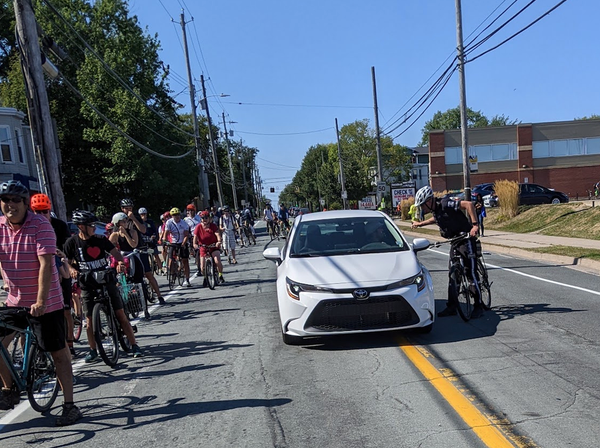
The consequences are also particularly significant for vulnerable road users. Although people walking and cycling account for a relatively small share of overall crashes, they are disproportionately represented in fatal and serious injury collisions, as we have noted previously.
HRM has adopted the language of Vision Zero. The next step is to adopt its core principle as a measurable goal: reducing fatalities and serious injuries to zero.
Vision Zero is not a slogan. It is a commitment to produce progressively safer outcomes. Until HRM adopts clear fatality and serious injury reduction targets, the gap between strategy and practice will remain.
In our next post, we’ll unpack three areas where HRM’s current Road Safety Strategy falls short of Vision Zero best practices, and the changes needed to make safe travels for everyone a reality. Make sure to sign up to stay up-to-date.