Twenty fatal collisions on our streets in 2025 is not 'favourable' progress
If zero means zero, then the most important number in the 2026 Road Safety Annual Report is twenty. At least twenty people died on HRM roads in 2025. Everything else is secondary.
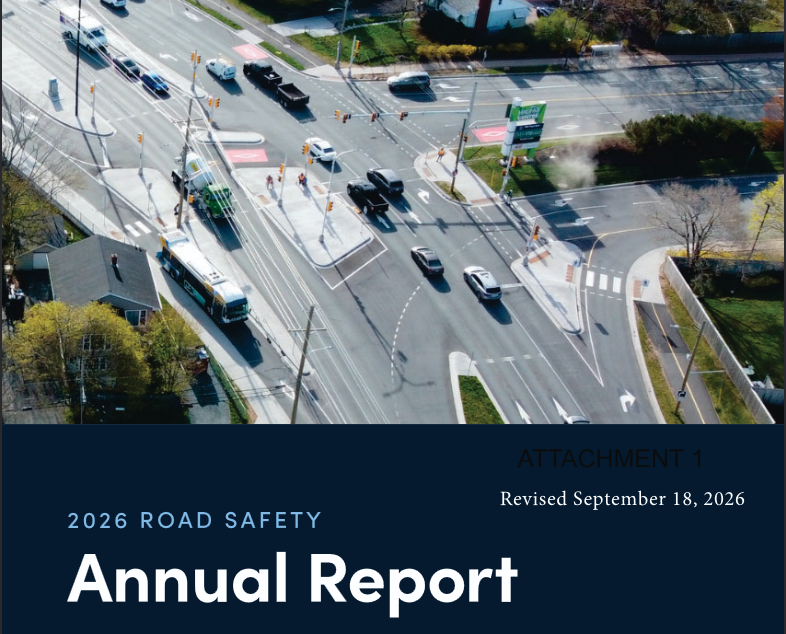
The 2026 Road Safety Annual Report is out and it is a deeply disturbing read. On the one hand, the report acknowledges that fatal collisions in the HRM increased dramatically in 2025. On the other, it repeatedly points to relatively stable collision rates, population growth, and somewhat arbitrary comparisons with other municipalities as evidence of 'progress'.
According to HRM's 2026 Road Safety Annual Report, twenty fatal collisions occurred on HRM roads in 2025, up from eleven the year before. That's an 82% increase in fatal collisions in a single year. At the same time, the number of fatal or serious injury collisions rose from 170 to 182. These are not the results of a transportation system moving toward Vision Zero, but of a system that continues to expose people to unacceptable risk. How can that be considered progress?
Putting a positive spin on traffic violence
Perhaps the most disturbing sentence in the accompanying briefing note to council is the assertion that HRM "continues to compare favourably with many Canadian municipalities on a population-adjusted basis" (briefing note, p.5). Comparisons to other cities are irrelevant, and frankly inappropriate, when the goal is to have zero deaths on our roads. The “compare favourably” language should only be with cities that have achieved zero deaths, and in the context of applying their lessons to our own policies, not dismissing such interventions as “cheating” while refusing to upgrade our streets to higher safety standards.
No one who has lost a loved one in a traffic collision in the HRM will be comforted by the fact that another city may have done an even worse job of preventing traffic deaths. Nobody whose life was permanently altered by a serious injury will benefit from the knowledge that the HRM ranks marginally better than somewhere else in Canada.
The foundation of Vision Zero is the understanding that every traffic death is preventable and that all levels of government have a responsibility to design transportation systems that anticipate human error and prevent it from becoming fatal. Using that lens, "we compare favourably" is meaningless. Twenty fatal collisions are twenty too many.
The report at least acknowledges that HRM remains above the trajectory required to achieve its Vision Zero objectives and that fatal and serious injury collision rates remain higher than the 2022 baseline. It repeatedly uses language such as "stable," "modest improvement," and "positive trends." But stability in the presence of ongoing death and serious injury is not success. If that wasn’t disappointing enough, the report spends more space discussing video views, impressions, followers and webpage traffic than discussing why fatalities nearly doubled (report, p.33).
Vision Zero requires us to measure impact by what matters most - whether people are being killed and seriously injured. Our transportation system is still killing people and our elected officials and city staff are not doing enough to change that.
The report notes that nearly three-quarters of fatal and serious injury collisions occurred on major transportation corridors and that one-third involved single-vehicle crashes commonly associated with speed, impairment, and other risk factors. It also reports that only 38% of drivers on sampled major roadways were complying with posted speed limits in 2025, down from 45% the previous year.
As we have shared before, a core principle of Vision Zero is that humans make mistakes. Adopting Vision Zero means designing roads that are forgiving of human error and that reduce excessive speeds, implementing policies with meaningful outcomes, and having systems of enforcement that ensure those mistakes do not become fatal. When speeding remains widespread and fatalities nearly double, the response cannot be satisfaction with marginal improvements elsewhere in the data.
Another alarming finding in the report is that public perception of safety dropped from 48% in 2024 to just 26% in 2025. People are clearly seeing and experiencing something that the municipality's optimistic messaging does not fully capture. We have heard the same concerns in our own incident reporting. These near misses provide evidence of the conditions that produce the crashes and fatalities Vision Zero is supposed to prevent.
Council must choose action over optics
If Council is serious about its commitment to Vision Zero, the response to this report cannot be another year of presentations, dashboards, and incremental change. We need action now on the following areas:
- Make every road death a public learning opportunity. Require transparent reporting on all fatal and serious injury collisions, including contributing factors, lessons learned, and the specific actions taken to prevent similar tragedies in the future. Transparency is essential if every death is to be treated as preventable rather than inevitable.
- Hold the system accountable through public reporting. Regularly publish enforcement, investigation, and follow-up actions arising from serious injury and fatal crashes, including progress on safety recommendations and known high-risk locations.
- Accelerate proven safety interventions where harm is occurring. Fast-track implementation of measures with demonstrated safety benefits, including protected signal phasing, protected left turns, speed management, safer crossings, and corridor redesigns on roads responsible for the majority of fatal and serious injury collisions.
- Refocus Vision Zero on outcomes, not optics. Measure success by lives saved, not social media impressions, engagement statistics, comparisons with other municipalities, or progress toward a "downward trend." Vision Zero is not about accepting fewer deaths. It is about preventing them.
As HRM's own road safety leadership has stated, "zero is zero." The benchmark must be lives saved. Write to your councillor and MLA today and demand a true Vision Zero action plan.
Note: This article has been updated from what was originally published to reflect that the data reported is 20 fatal collisions, not deaths.