Support transit priority measures in the Halifax Regional Municipality
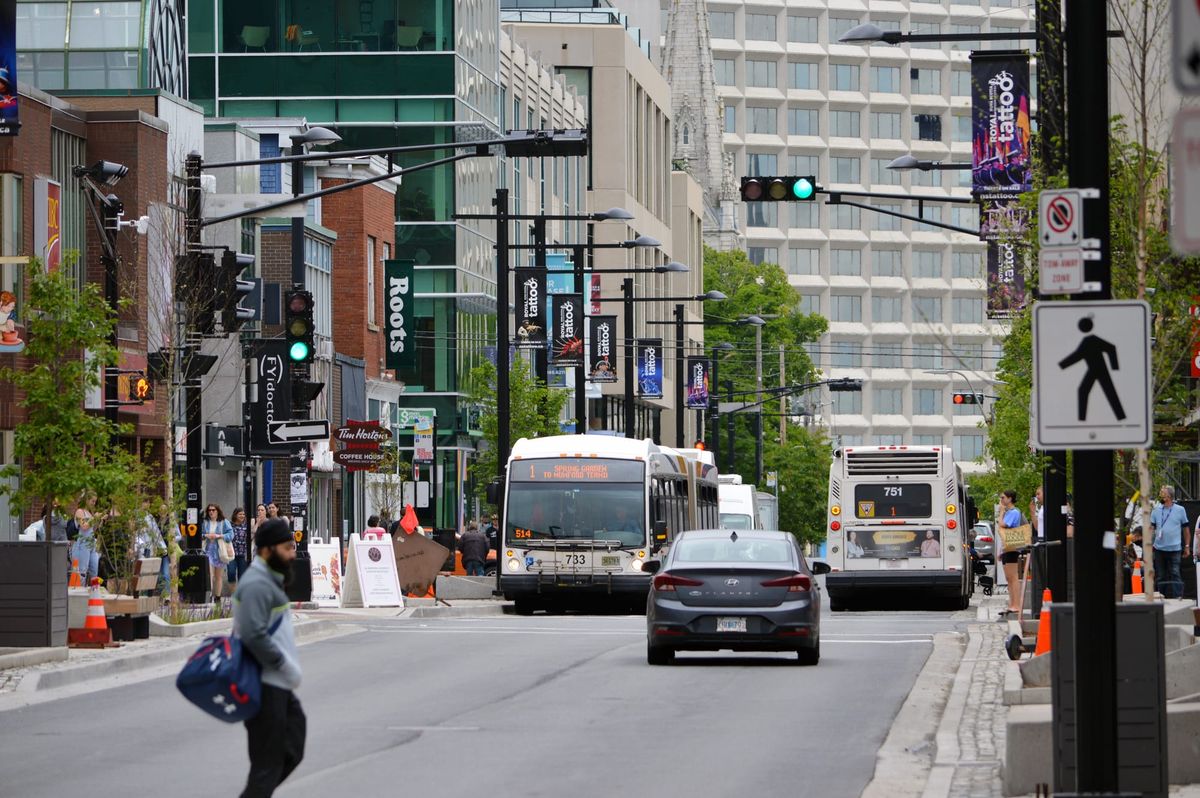
Vision Zero Kjipuktuk-Halifax strongly supports improving transit reliability through enhanced parking enforcement on key corridors and the implementation of transit-priority street design measures. Such actions reflect a core principle of Vision Zero - that traffic deaths and serious injuries are preventable and are shaped by policy and design.
The IMP update report highlights a clear challenge to the Halifax Regional Municipality (HRM) because our urban/suburban transportation system is constrained, congested, and heavily dependent on private vehicles (pages 4-6), meaning that:
- The majority of trips in the HRM are still made by car, often containing a single occupant, and our municipal mode share goal is moving in the wrong direction
- Key corridors are operating near or at capacity, and transit is stuck in costly congestion
- Geographic constraints and the high cost for road maintenance limit the ability to expand road space
Halifax cannot build its way out of congestion by adding road capacity. The issue is not a lack of space, it is how that space is used.
The original IMP report reinforces an important and often misunderstood reality - congestion is driven by the number of vehicles, not the number of lanes. In a transportation network where 81% of trips are made by private car, as noted in the IMP update to Council, road space is fixed and cannot accommodate further widespread use of private cars. Demand is growing not just because of population growth but to a lack of political attention to supporting viable transportation alternatives. Adding more general traffic capacity will not solve congestion and will worsen it over time through the well established principle of induced demand.
Transit priority measures like dedicated bus lanes, signal priority, and removal of parking conflicts are among the most effective ways to move more people within limited space by:
- Increasing the person-carrying capacity of corridors
- Improving reliability and travel time
- Enabling a mode shift away from private vehicles
This is essential in a constrained network, where the goal, and the role of this Council, must be to move more people, not more cars in the most cost-effective way possible.
It is also highly relevant in the context of affordability concerns, exacerbated by current volatile fuel prices. A transportation system centred on private vehicles exposes households to rising and unstable costs and limits mobility for those who cannot or do not drive, or who cannot afford to drive in the face of these fiscal headwinds. By investing in transit and enabling active transportation Council can help constituents to move more safely, efficiently and cheaply, while protecting the municipal budget by reducing dependence on fossil fuels.
Safe, efficient streets are not accidental, they are the result of deliberate choices about how we allocate space and prioritise movement, and these rely on Councillors to act on decades of evidence. In a constrained system like Halifax, prioritising transit is a necessity.
This is a summary version of a position statement submitted to the Halifax Regional Council on March 30, 2026.